 Afrikaans
 Azərbaycan
 Bosanski
 Čeština
 Dansk
 Deutsch
 English
 Español
 Filipino
 Français
 Hrvatski
 Indonesia
 Italiano
 Magyar
 Melayu
 Nederlands
 Norsk
 Oʻzbek
 Polski
 Português
 Română
 Slovenčina
 Slovenščina
 Suomi
 Svenska
 Tiếng Việt
 Türkçe
 Ελληνικά
 Беларуская
 Български
 Русский
 Српски
 Українська
 עברית
 اردو
 العربية
 پښتو
 فارسی
 አማርኛ
 मराठी
 বাংলা
 தமிழ்
 ไทย
 မြန်မာ
 한국어
 中文
 日本語


Home-scale vertical wind turbines and battery selection is not just about buying a turbine for users who want to generate small-scale electricity on their rooftops or in their gardens; it is an engineering challenge that involves calculating wind potential, daily consumption, charge controllers, inverters, battery chemistry, cable sizes, and safety measures together. The short answer is this: In locations where the average wind speed is below 4.5 m/s, home-scale vertical wind turbines should not be considered as the sole energy source; a turbine in the range of 500 W to 2 kW should be designed as a hybrid system to support lighting, modems, security cameras, mini refrigerators, or critical loads when combined with a realistically calculated battery bank of well-chosen LiFePO4 or gel batteries.
This guide explains the logic of measurements, calculations, and selections that work in the field, rather than relying on catalog data and setting unreasonable expectations. The marketing language in wind turbines is often built around nominal power; for example, a product labeled 1000 W only delivers that power at specific and often high wind speeds. However, the critical question for home users is: How many kWh can be produced at my location each month, and which battery can safely store this production? To answer this question, a straightforward yet disciplined method needs to be followed for both aerodynamic and electrical aspects.
The fundamental principle while discussing technology infrastructures on the Hostragons blog is the same: the weakest link in a system determines its entire performance. Just as poor hosting can slow down a quick theme on websites, incorrect battery selection can render an efficient turbine ineffective in a wind energy system. If you want to publish your energy monitoring dashboard or maintenance records online, Website Creation Guide can be helpful, Domain Lookup and Registration can assist in branding your domain with your energy project, and What is SSL Certificate can secure your panel delivery.
What is a Home-Scale Vertical Wind Turbine?
A home-scale vertical wind turbine is a small-scale electricity generation device with a rotational axis perpendicular to the ground, capable of capturing wind from various directions rather than from a specific direction like horizontal-axis turbines. These turbines are typically marketed in the range of 100 W to 3000 W; however, the most common range for home applications is between 400 W and 1500 W. The primary advantage of the vertical axis design is its reduced dependency on wind direction, which allows it to operate more effectively in turbulent urban and rural environments. The downside is that it often provides lower efficiency compared to horizontal-axis turbines for the same swept area.
Vertical turbines are particularly considered for locations such as rooftops, garden poles, farmhouses, caravan areas, security booths, telecom cabins, or seaside cottages. However, wind strength is not always consistent above a roof; turbulence created by buildings, chimneys, trees, and neighboring structures can significantly reduce the expected production of the turbine. Therefore, it is essential to conduct at least a few weeks of wind observation and, if possible, to take measurements with an anemometer before selecting a product.
Savonius, Darrieus, and Hybrid Models
There are three main approaches in home-scale vertical turbines. Savonius-type models have a scoop-like blade design that allows for easy startup in low wind conditions, but high efficiency should not be expected. Darrieus-type models can provide better efficiency with more aerodynamic blades, although their starting torque may be low. Hybrid models aim to combine Savonius and Darrieus geometries to achieve stable production in moderate winds while allowing for startup in low wind conditions.
- Savonius: Good startup in low winds, low efficiency, easy maintenance.
- Darrieus: Better efficiency, design quality is crucial for startup, mechanical loads are more pronounced.
- Hybrid: May be a balanced option for home users, but quality variations can be significant.
How to Assess Wind Potential?
The most critical variable in wind energy is wind speed, as the power carried by wind increases with the cube of speed. Simply put, a wind speed of 6 m/s, while being twice the speed of 3 m/s, results in an energy potential approximately eight times greater. Therefore, even a difference of 1-2 m/s can determine whether a home-scale system will succeed economically and technically.
In preliminary exploration, the following steps can be implemented: First, consult the General Directorate of Meteorology, regional wind maps, and nearby station data. Then, measurements should be taken at the installation height of the turbine, preferably between 6-12 meters using an anemometer. A week of measurements provides some insight but is too short for a decision; ideally, recordings should last at least 30 days, and preferably 3-6 months. In measurements, not only the average speed but also gusts (sudden wind values) are important, as strong gusts can pose risks in terms of braking and mechanical endurance.
Practical Field Checklist
- Is there a high obstacle cutting the wind within a radius of at least 10 meters around the turbine?
- Can the pole height exceed at least 3 meters above the roof or surrounding obstacles?
- Is the average wind speed 4.5 m/s or higher?
- Will noise, vibration, and shadow effects disturb neighbors?
- Is permission required from the municipality, site management, or zoning regulations?
- Will manual or automatic braking be possible during storms?
If several of these questions receive negative answers, it may be more appropriate to reduce the system size, switch to a hybrid solar-wind solution, or design a backup system that only supports critical loads. Wind energy plays a strong role in hybrid systems, especially since it can complement solar panels during nighttime and winter months.
Real Production Calculation: Don't Be Misled by Nominal Power
Just because a turbine is labeled as 1000 W does not mean it will continuously produce 1000 W. Nominal power is usually measured at high wind speeds of 10-12 m/s. In many residential areas in Turkey, the average wind speed at rooftop level ranges from 2.5-5 m/s. Therefore, the daily average production of a 1000 W turbine may be as low as 0.5 kWh on some days, while on windy days, it could reach 3-5 kWh; during calm periods, it could nearly drop to zero.
A simple design approach can use the following logic: First, list daily consumption. For example, a 10 W LED light running for 5 hours consumes 50 Wh, a 15 W modem running for 24 hours consumes 360 Wh, and a 60 W mini fridge may consume 600 Wh daily due to its compressor cycle. These three items total approximately 1010 Wh or 1.01 kWh. When adding losses, it is wise to plan for 1.2-1.4 kWh of energy daily.
When losses from the charge controller, battery, and inverter are not accounted for, the system may look correct on paper but may fall short in practice. In small systems, total losses can range from 15-30 percent. Therefore, leaving at least a 25 percent safety margin in the design is a good engineering habit.
Criteria for Selecting Home-Scale Turbines
When choosing a turbine, it is essential to evaluate mechanical quality, blade material, generator type, certification, spare parts availability, and braking mechanisms together, rather than just looking at the wattage. Especially in cheap and unbranded products, the quality of bearings, water resistance, balance, and actual power curve can be uncertain. A wind turbine is a rotating machine; therefore, a failure can pose not only a production loss but also a safety risk.
Important Technical Parameters
- Cut-in wind speed: The speed at which the turbine starts rotating; it should not be confused with the speed at which it produces.
- Operational wind range: Indicates the speed band in which it can operate continuously and safely.
- Rated wind speed: The wind speed at which it reaches its labeled power.
- Maximum safe wind: Critical for storm resistance.
- Voltage level: Determines the system architecture, whether it is 12 V, 24 V, or 48 V.
- Braking: Should include electromagnetic, mechanical, or controller-based protection.
In systems below 500 W, 12 V can be used; however, as cable currents increase, 24 V or 48 V is more efficient in designs of 800 W and above. For instance, the theoretical current of 1000 W in a 12 V system is 83 A, while in a 48 V system, it is approximately 21 A. Lower current means thinner cables, less heating, and reduced voltage drop.
Battery Selection: The Heart of the System
Home-scale vertical wind turbines and battery selection should be considered together because wind is irregular, and proper storage is needed for the produced energy to be usable. The battery bank balances the instantaneous production of the turbine, supplies loads during nighttime and windless hours, and provides stable DC energy to the inverter. Incorrect battery selection can lead to low capacity, early failure, swelling, fire risks, or shorter-than-expected backup durations.
The most common battery options for home users are flooded lead-acid, AGM, gel, and LiFePO4 batteries. Flooded batteries are inexpensive but require maintenance and ventilation due to gas release. AGM and gel batteries are sealed and easier to use, but they are limited against deep discharges. LiFePO4 batteries are more expensive but offer a long cycle life, high usable capacity, and better safety profiles.
| Battery Type | Usable Capacity | Cycle Life | Advantages | Considerations |
|---|---|---|---|---|
| Flooded Lead-Acid | About 50% | 300-700 cycles | Low initial cost | Requires maintenance and ventilation |
| AGM | About 50% | 400-800 cycles | Sealed, easy installation | Deep discharge shortens lifecycle |
| Gel | About 50-60% | 600-1000 cycles | Common in off-grid systems | Charge voltage is sensitive |
| LiFePO4 | About 80-90% | 2000-6000 cycles | Long life, lightweight, efficient | BMS and compatible charger required |
How to Calculate Battery Capacity?
To calculate battery capacity, first determine the daily energy requirement, then add the autonomy period and depth of discharge. The formula can be simplified as follows: Required battery energy = daily consumption x autonomy days / usable discharge rate. For example, if a system consumes 1.2 kWh daily and 2 days of backup is desired, using a LiFePO4 battery at 80% depth of discharge gives a required capacity of 1.2 x 2 / 0.8 = 3 kWh.
This capacity corresponds to approximately 125 Ah in a 24 V system; as 24 V x 125 Ah = 3000 Wh. If aiming for 50% discharge in a lead-acid gel battery, the same scenario would require 1.2 x 2 / 0.5 = 4.8 kWh. In a 24 V system, this equates to approximately 200 Ah of capacity. As can be seen, while LiFePO4 may seem expensive at first, a smaller capacity can be adequate for the same usable energy.
Charge Controller, Inverter, and Cable Selection
In wind turbine systems, the charge controller must behave differently than those for solar panel systems. When the turbine is unloaded, it can overspeed; therefore, the wind controller should include dump load, which is a load resistor that dissipates excess energy, and a braking function. Directly connecting a charge controller made for solar panels to a wind turbine is often not advisable.
Choosing the inverter should be based on the load characteristics. For small electronics like modems, LED lighting, and cameras, a pure sine wave inverter is recommended. For refrigerators, pumps, or motorized devices, starting currents can be 3-7 times the rated power. For instance, a small refrigerator running at 150 W may require 600-900 W at startup. Therefore, a 1000 W pure sine wave inverter is usually a safe starting point for small critical household loads; larger systems consider 2000 W and above.
Practical Approach for Cables and Fuses
In low-voltage DC systems, cable size is vital. Voltage drop increases over long cable runs, cables heat up, and system efficiency decreases. The distance between the turbine and the controller should be kept as short as possible; outdoor cables should be UV-resistant, and connections should be protected from water and corrosion. Each battery bank should have appropriate DC fuses, disconnect switches, and, if possible, surge protectors.
- In 12 V systems, larger cable sizes should be selected due to high currents.
- 24 V and 48 V systems are more efficient and safer at medium power.
- Battery terminals should not be left loose, and lugs should be properly tightened.
- DC fuses should be placed as close to the battery as possible.
- Grounding should be done professionally in areas with lightning risk.
Example System Design: A Small Rural Home
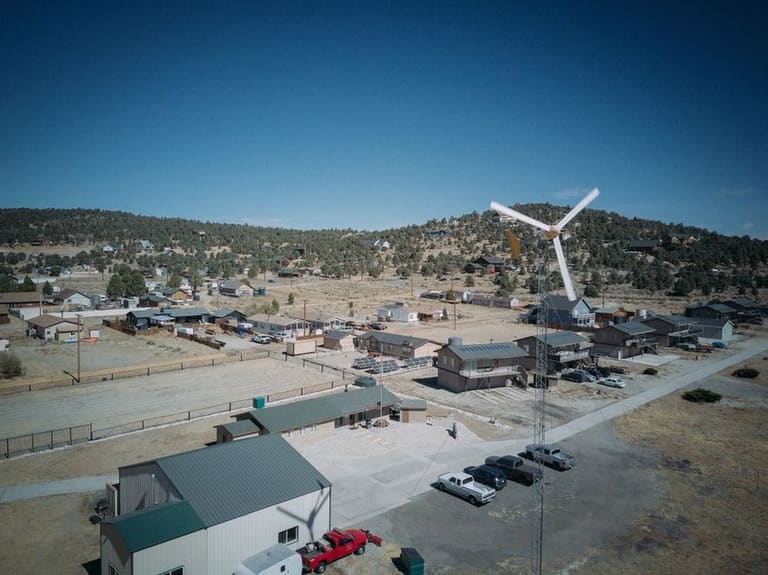
Let’s move forward with a concrete scenario. Consider a rural home that will be powered by nighttime lighting, a modem, two security cameras, and a small refrigerator. Daily consumption: LED lighting 200 Wh, modem 360 Wh, cameras 240 Wh, refrigerator 700 Wh, totaling 1500 Wh. Including losses, the daily target can be approximately 1900 Wh or 1.9 kWh.
If the average wind measured at the location is 5.2 m/s, a quality 1000 W class vertical turbine could provide an average daily contribution of 1-3 kWh depending on the season. If aiming for 2 days of autonomy for windless days, the LiFePO4 battery capacity required would be 1.9 x 2 / 0.8 = 4.75 kWh. This corresponds to a battery bank of around 48 V 100 Ah. For the inverter, a 1500-2000 W pure sine wave model can be selected, and for the wind controller, a compatible dump load model should be chosen.
Adding solar panels to this design can enhance efficiency. For example, an 800 W solar panel can support the battery during the day when wind is weak in the summer; in winter, when wind increases, the turbine will contribute more. Such a hybrid setup is often more stable compared to systems reliant solely on wind or solar.
Safety and Maintenance in Installation
While vertical wind turbines may seem small, they require attention due to rotating blades, pole connections, and high-current DC lines. Installation must be done with a sturdy foundation, correct anchoring, stainless connectors, and vibration control. With rooftop installations, vibrations can be transferred into the building; therefore, a standalone pole is often a better solution. In pole calculations, regional storm speed, turbine weight, moment arm, and soil structure should be considered.
A maintenance program is one of the most critical factors determining system lifespan. After the initial installation, connection bolts, cable entries, bearing sounds, and balance should be checked one month later. Then, a visual inspection every six months and a detailed mechanical and electrical check annually are recommended. On the battery side, cell voltages, BMS alerts, temperature records, and depth of discharge should be monitored.
Remote Monitoring and Data Logging
Data logging in energy systems enhances decision quality. When daily production, battery state of charge, wind speed, and load consumption are recorded, it becomes clear whether the system operates as expected. It is possible to set up a simple IoT dashboard to display data online. Reliable server infrastructure is required for such dashboards; for small projects, Linux Hosting Packages, for more flexible applications What is VPS Server, and for data security, Web Security Checklist can be considered.
Costs, Returns, and Realistic Expectations
In home-scale vertical wind systems, costs are not limited to the turbine price. The total budget includes the pole, foundation, cables, controllers, batteries, inverters, fuses, protective equipment, installation labor, and maintenance items. By 2026, in a quality small system, the battery bank often becomes one of the largest items in the total cost. While choosing LiFePO4 increases initial investment, the long cycle life and usable capacity can reduce the total cost of ownership in the long run.
When calculating returns, the unit price of grid electricity, the system's annual kWh production, and the battery replacement costs should be considered together. If the goal is solely economic return, investing in a location with weak wind may not be attractive. However, if reasons such as reducing grid outages, powering a remote structure, keeping security cameras operational, or sustainability goals exist, the value may not only be measured by bill savings.
| Scenario | Recommended Approach | Risk | Suitable Battery |
|---|---|---|---|
| Urban rooftop, low wind | Small turbine or solar-dominant hybrid | Turbulence and low production | AGM or small LiFePO4 |
| Rural open land | 1-2 kW vertical turbine, standalone pole | Storm and maintenance requirements | LiFePO4 or gel |
| Holiday home and security loads | Wind + solar + critical load panel | Lack of off-season monitoring | LiFePO4 |
| Telecom or camera point | Small turbine, high autonomy | Access and maintenance difficulties | Long-life LiFePO4 |
10-Step Engineering Plan Before Purchase
Following this sequence for a successful system reduces errors:
- List daily loads in Wh.
- Separate critical and non-critical loads.
- Measure wind at the installation site.
- Examine the turbine power curve independently of the nominal watt value.
- Determine the system voltage as 12 V, 24 V, or 48 V.
- Calculate battery capacity based on autonomy days.
- Compare battery chemistry in terms of budget, lifespan, and safety.
- Select a wind-compatible charge controller with dump load.
- Design cables, fuses, surge protectors, and grounding.
- Regularly monitor production and consumption data after installation.
Purchasing before completing these steps often results in either an unnecessarily large and expensive system or one that fails to meet needs. The engineering approach is to measure the need and source first, and then select the equipment.
Common Mistakes
The most frequent mistake in home wind projects is interpreting the maximum power listed for a product as its annual production. The second major mistake is assessing battery capacity based solely on amp-hours while ignoring voltage and usable discharge rates. A 12 V 100 Ah battery does not hold the same energy as a 24 V 100 Ah battery; the former contains approximately 1.2 kWh, while the latter contains about 2.4 kWh. Moreover, using the entire capacity of lead-acid batteries can significantly shorten their lifespan.
Another mistake is directly mounting the turbine onto the roof. While rooftop installation may seem straightforward, it can lead to issues with vibration, water insulation, and turbulence. Additionally, access can become difficult during storms. If possible, an independently calculated pole should be preferred. Finally, DC electrical safety should not be underestimated; even low voltage can pose fire risks due to high current.
Frequently Asked Questions
Can a home-scale vertical wind turbine fully power a home?
Generally, it is not sufficient to power an entire home on its own. Systems installed in high, open areas with a large battery bank may support some loads for extended periods; however, in urban applications, a more realistic goal is to support critical devices or operate in hybrid with solar energy.
How many kWh does a 1000 W vertical wind turbine produce per day?
This value depends on wind speed, turbine quality, and installation height. In a good location with an average wind speed of 5 m/s, daily production of 1-3 kWh may be observed; however, production can fall significantly in low-wind and turbulent rooftop environments.
Is a gel battery better than a LiFePO4 battery for wind turbines?
If the budget is limited, a gel battery can be used; however, due to its long cycle life, higher usable capacity, and lower weight, LiFePO4 is generally more advantageous in most modern home systems. When choosing LiFePO4, a BMS and compatible charge controller are essential.
Which system voltage should be chosen: 12 V, 24 V, or 48 V?
For small systems below 500 W, 12 V can be practical. In the range of 500-1500 W, 24 V is more efficient, and for higher powers, 48 V is safer. As system voltage increases, the current decreases for the same power, reducing cable losses and heating.
Is permission required for a vertical wind turbine?
Permission may be necessary depending on local regulations, municipality, site management, roof status, and pole height. It is essential to consult with the municipality, distribution company, and apartment or site management before installation, particularly if a grid-connected setup is planned.
Conclusion: Measure, Calculate, Then Purchase
When done correctly, selecting home-scale vertical wind turbines and batteries provides a valuable investment that ensures resilience against outages, enhances renewable energy consciousness, and protects critical loads. Success requires measuring the wind first, calculating consumption in Wh, determining battery capacity based on real usable energy, and thoroughly planning safety equipment. If you want to monitor your energy data, document your project, or share your experience through a technical blog, you can explore Hostragons' infrastructure solutions; with suitable hosting, domain, and SSL options, you can create a secure digital record space.