 Afrikaans
 Azərbaycan
 Bosanski
 Čeština
 Dansk
Dansk Deutsch
 English
 Español
 Filipino
 Français
 Hrvatski
 Indonesia
 Italiano
 Magyar
 Melayu
 Nederlands
 Norsk
Norsk Oʻzbek
 Polski
 Português
 Română
 Slovenčina
 Slovenščina
 Suomi
Suomi Svenska
 Tiếng Việt
 Türkçe
 Ελληνικά
 Беларуская
 Български
 Русский
 Српски
 Українська
 עברית
עברית اردو
اردو العربية
 پښتو
پښتو فارسی
فارسی አማርኛ
አማርኛ मराठी
मराठी বাংলা
বাংলা தமிழ்
தமிழ் ไทย
ไทย မြန်မာ
 한국어
한국어 中文
中文 日本語
日本語

Urban Digital Twins usher in a new era for city management by enabling advanced modeling and optimization. In this article, we’ll explore what urban digital twins are, how they work, and the concrete benefits they offer. We’ll cover use cases like infrastructure planning, traffic optimization, energy efficiency, disaster preparedness, and more. You’ll also learn about the practical steps for building your own digital twin, plus the challenges and solutions cities need to tackle. Future trends, ethical considerations, and security issues round out the guide, ensuring you get actionable insight into how digital twins can help your city thrive.
Urban Digital Twins: Ushering In The Next Generation Of Cities
Today’s cities face complex challenges as they push for a more sustainable future. That’s where urban digital twins come in: they’re virtual replicas of real cities, mirroring their physical and social infrastructure, demographics, environmental factors, and more—often updated in real-time. City managers and planners can use these models to make smarter choices and shape a resilient urban future.
An urban digital twin is packed with potential. It can help optimize traffic flows, reduce energy consumption, simulate disaster responses, test urban development projects, and ultimately improve citizens’ quality of life. With this technology, cities gain a toolbox for tackling tomorrow’s challenges ahead of time.
Main Advantages of Urban Digital Twins
- Evidence-based decision making
- More efficient use of resources
- Support for sustainability goals
- Greater citizen engagement
- Better urban planning and development
- Upgraded risk and crisis management
However, urban digital twins aren’t a magic bullet. Like any advanced tech, implementation comes with hurdles: data privacy and security, infrastructure gaps, costs, and the need for skilled experts all require careful attention. When cities tackle these challenges, digital twins become a powerful springboard for transforming how urban environments are planned and managed.
Urban digital twins are most effective when city leaders, planners, researchers, and technology developers collaborate. Only by working together can a digital twin reach its full potential—delivering innovative solutions for urban problems and helping every resident enjoy a higher quality of life.
What Are Urban Digital Twins?
An urban digital twin is a comprehensive virtual copy of a real city, built in a digital environment. This technology gives planners and managers a powerful tool to simulate, understand, and optimize the complex systems that make up a city. With digital twins, you can test scenarios, predict impacts, and make more confident, future-proof decisions.
Unlike static maps or simple visualizations, urban digital twins are dynamic, continuously updated with live data from sensors, cameras, IoT devices, and many other sources. That real-time data can reflect traffic flows, air quality, energy use—even social activity. By constantly monitoring a city’s pulse, a digital twin lets you spot issues early and intervene proactively.
Core Components of Urban Digital Twins
- Real-time data capture: Continuous flows from varied city sources
- 3D modeling and visualization: Accurate representations of geography and architecture
- Simulation and analysis tools: Software for scenario testing and impact assessment
- Integration and interoperability: Bringing together different systems and datasets
- User interfaces and accessibility: Presenting data in understandable, actionable ways
A digital twin helps cities become more sustainable, livable, and efficient. For example, you can simulate the effect of a new transit line on congestion or assess the potential savings from an energy efficiency campaign. These analyses help cities deploy resources more effectively—and minimize their environmental impact.
Building and applying urban digital twins demands large-scale data, advanced tech, and expertise. The investment pays off as cities become smarter, more resilient, and more enjoyable for everyone. Looking ahead, urban digital twins are likely to become a foundational part of city management.
How Urban Digital Twins Work
Urban digital twins are advanced tools for analyzing, understanding, and optimizing the interconnected systems of a city. By creating a virtual representation of a physical city—and constantly updating it with real-time data—digital twins help city managers test scenarios, anticipate problems, and design sustainable, vibrant urban environments.
The basic principle: diverse data sources are integrated from sensors, cameras, GIS (Geographic Information Systems), and other smart city tech. This information is then assembled into detailed 3D models, capturing both physical and social infrastructure. Key urban dynamics like energy, traffic, air quality, and population density can now be analyzed within a digital environment.
Sources and Uses of Urban Digital Twin Data
| Data Source | Data Type | Application |
|---|---|---|
| Sensors | Live temperature, humidity, air quality | Environmental monitoring, pollution management |
| Cameras | Video & image streams | Traffic analysis, security monitoring |
| GIS | Mapping, land use info | Urban planning, resource allocation |
| Social Media | Geotagged posts, comments | Public sentiment, event detection |
Making an urban digital twin effective relies on several principles: maintaining high data quality, keeping models accurate and updated, and designing interfaces that match user needs. Security and privacy are equally essential for sustainable and ethical digital twin use. Key Operating Principles:
- Data Integration: Combining inputs from various sources
- Real-Time Updating: Keeping information fresh and relevant
- 3D Modeling: Digitally mapping physical city structures
- Simulation Capabilities: Scenario-testing inside the virtual city
- Analytical Tools: Turning raw data into meaningful insights
- User-Friendly Interfaces: Easy access for planners and managers
Data Collection Methods
Gathering the right data is foundational for urban digital twins. Sensors capture information on air quality, traffic, and energy usage; cameras monitor flows and incidents; GIS delivers spatial and infrastructure context; social media analysis uncovers citizen reactions and emerging events. When these inputs are accurate and current, the digital twin paints a true-to-life picture of the city’s pulse.
Simulation Processes
Simulation is at the core of an effective urban digital twin. Planners can test “what if?” scenarios—will new transit reduce congestion, will disaster evacuation routes function, will energy-saving measures work? By visualizing outcomes before making real-world changes, cities save time, money, and resources. This approach paves the way for data-driven, confident urban management.
Urban digital twins are set to play a pivotal role in shaping the cities of tomorrow. By enabling data-driven decisions, we create living environments that are smarter, greener, and more resilient.
Urban Digital Twins Benefits & Challenges
While urban digital twins revolutionize planning and management, they also introduce unique obstacles. Unleashing their full potential means tackling challenges head-on—data quality, infrastructure, and ethics all matter. Digital twins serve as a powerful tool for simulating, understanding, and optimizing city systems—but success hinges on thoughtful implementation.
The greatest strength of urban digital twins lies in smarter decision making. Through real-time data and simulation, city managers can make more effective choices—like resolving congestion or coordinating resources during a crisis. Disaster scenarios, evacuation routes, and emergency resource allocation can all be modeled ahead of time, enhancing preparedness.
Key Benefits of Urban Digital Twins
- Sharper Decision Making: Data and simulation drive confident choices
- Resource Optimization: Smarter use of energy, water, and other city assets
- Sustainability: Minimizing environmental footprints
- Traffic Management: Real-time flow optimization
- Emergency Response: Faster, more effective disaster interventions
- Urban Development: Predicting project impacts and enhancing planning
But digital twins are not without hurdles. Privacy, cybersecurity, and patchy infrastructure top the list. Integrating diverse data sources and standardizing formats is technically challenging. Cities need robust data security protocols, investments in technology, and clear standards to overcome these barriers.
Challenges and Solutions
Implementing urban digital twins faces technological, organizational, and financial challenges. Ensuring data quality requires continual effort, and integrating disparate sources is tough. Cost can be a stumbling block, especially for smaller cities. Solutions include adopting open data standards, encouraging public-private partnerships, and prioritizing affordable tech options.
Urban Digital Twins: Benefits vs Challenges
| Area | Benefits | Challenges |
|---|---|---|
| Planning | Sustainable development, improved urban design | Complex data integration and modeling |
| Management | Efficient resource allocation, quicker decisions | Data privacy, cybersecurity |
| Environment | Reduced impact, better energy efficiency | Ensuring high-quality, up-to-date data |
| Economy | New jobs, economic growth | Cost, technological infrastructure |
Unlocking the full potential of urban digital twins demands a strategic mindset and ongoing development. Education and outreach help managers and citizens understand the technology’s value. International collaboration and knowledge sharing spread best practices and foster continual innovation.
Main Applications of Urban Digital Twins
Urban digital twins are game-changers for planning and administration with applications that span traffic management, energy efficiency, disaster response, sustainable development, and more. They’re key to building smarter, more livable, and greener cities.
Sector-Specific Use Cases
- Traffic Optimization: Analyze live traffic to minimize jams and streamline flows
- Energy Efficiency: Model building consumption for savings and integrate renewables
- Disaster Response: Simulate emergency plans for better preparedness and resource allocation
- Infrastructure Planning: Assess new infrastructure projects for design and placement
- Environmental Sustainability: Monitor air, water, and green spaces to guide planning
- Citizen Engagement: Collect feedback and involve residents via interactive platforms
The table below summarizes main sectors, digital twin use cases, and potential benefits:
| Sector | Use Case | Potential Benefits |
|---|---|---|
| Transport | Traffic simulation, transit optimization | Improved flows, shorter travel times, fuel savings |
| Energy | Consumption modeling, smart grid management | Higher efficiency, lower carbon emissions, cost cuts |
| Construction | Building performance analysis, sustainable design | Greener, cheaper buildings, minimal environmental impact |
| Environment | Air quality modeling, water management | Cleaner air, sustainable water use, risk reduction |
Urban digital twins tackle current problems and future challenges—helping us understand complex city systems and make smarter decisions that raise quality of life. By promoting transparency and active citizen participation, digital twins transform city management into a more democratic and inclusive experience.
To maximize the potential of urban digital twins, cities must keep privacy, security, and ethical concerns front and center—while engaging all stakeholders for broad-based impact.
The Steps to Build an Urban Digital Twin
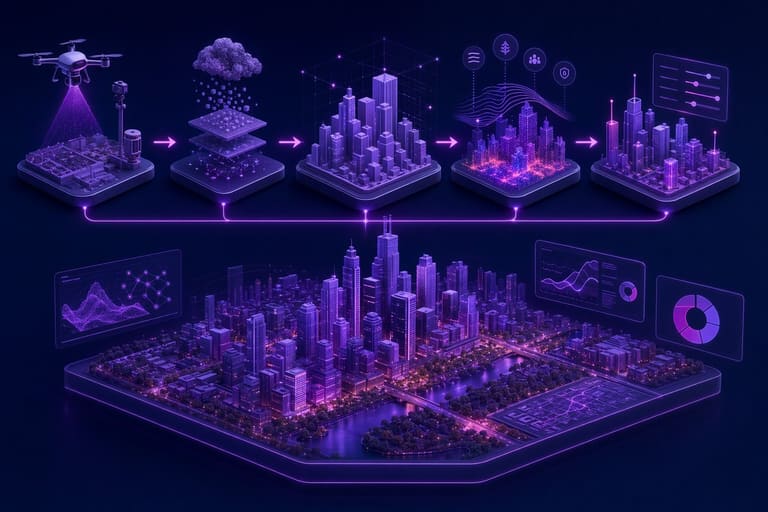
Setting up an urban digital twin is complex—with many stages, from data gathering to ongoing real-world updates. Success depends on careful planning and execution tailored to city needs and goals.
Data is the foundation. Urban digital twins collect info from GIS, sensors, cameras, IoT devices and more—covering traffic, air, energy, water, buildings, and demographics. Accuracy, reliability, and timeliness are essential, as the quality of input data directly impacts the twin’s reliability.
| Step | Description | Key Considerations |
|---|---|---|
| Data Collection | Gathering city data via GIS, sensors, IoT, etc. | Accuracy, reliability, timeliness |
| Data Integration & Processing | Combining, cleaning, and making data meaningful | Format compatibility, quality assurance |
| Model Building | Create 3D models and simulations from processed data | Real-world fidelity, scalability |
| Simulation & Analysis | Test and analyze urban scenarios on the twin | Proper parameterization and interpretation |
After collecting raw data, it must be integrated and processed—cleaned, harmonized, and converted into useful formats. Statistical analysis and machine learning can extract actionable insights, boosting the accuracy and power of your twin.
Recommended Workflow
- Needs Assessment: Identify which issues and goals matter most
- Source Selection: Decide what data to collect and where it will come from
- Technical Infrastructure Setup: Build hardware and software platforms for collection, processing, modeling
- Model Development: Construct and calibrate the 3D twin for real-world alignment
- Simulation & Analysis: Run scenarios, analyze results, and evaluate impacts
- Continuous Update & Improvement: Evolve the twin as conditions change and new data emerges
Leveraging the twin and its insights supports better real-world city management and planning. Feedback from the digital twin should drive continuous learning and strategy refinement—making cities more resilient, sustainable, and adaptable.
City Management with Urban Digital Twins
Urban digital twins are transforming how city managers understand and run their cities. Armed with real-time intelligence, leaders gain deep visibility into traffic, energy, air quality, and public services, enabling smarter and more responsive strategies.
| Area | Description | Digital Twin Contribution |
|---|---|---|
| Traffic Management | Optimize flows, reduce bottlenecks | Simulate routes with live data to propose alternatives |
| Energy Efficiency | Monitor and enhance building consumption | Forecast energy use for smarter allocation |
| Disaster Management | Improve disaster readiness and response | Model crisis scenarios for better planning |
| Public Services | Boost service efficiency (waste, water, etc.) | Optimize routes and utilize resources more wisely |
Planners can streamline resource allocation, meet sustainability goals, drive citizen engagement, upgrade infrastructure, and strengthen risk management using these smart tools.
Urban Digital Twins Impact Areas
- Resource allocation optimization
- Progress toward sustainable development goals
- Enhance citizen involvement
- Upgrade urban planning processes
- Proactive risk and crisis management
- Improve infrastructure efficiency
Urban digital twins help cities become smarter, greener, and more livable. But it’s critical to address privacy, security, and ethical concerns to fully realize their transformative potential.
Urban digital twins are poised to revolutionize city management, making decisions more data-driven and responsive—laying the foundation for the cities of tomorrow.
The Future of Urban Digital Twins
As digital twins mature, their impact in city planning and management will only grow. Integrating AI and ML will give twins predictive power—letting cities see around corners and take preemptive action. Plugging in IoT devices, AR/VR, and big data analytics will deepen their reach.
| Technology | Application Area | Anticipated Advances |
|---|---|---|
| AI | Traffic & energy optimization | Learning, adaptation, stronger prediction |
| IoT | Sensor data, smart infrastructure | More device integration, richer real-time data |
| AR / VR | Planning, simulation, public engagement | Immersive, user-centric interfaces |
| Big Data Analytics | Decision making, resource management | Faster, more precise insights, tackling complex challenges |
Emerging Trends & What’s Next
- Smarter Infrastructure: Efficient, sustainable management of water, energy, and transit
- Greater Citizen Participation: Residents can have a stronger voice in planning
- Advanced Disaster Response: High-fidelity simulations for crisis preparedness
- Green Urban Design: Lower energy use, improved waste, minimized environmental impacts
- Data-Driven Leadership: Decision makers rely on digital twin intelligence
As digital twins spread, privacy and cybersecurity will take center stage. Real-time urban data can trigger concerns about surveillance and misuse—so cities must enforce transparency, anonymization, and robust protection. Tech isn’t enough—public trust is essential.
Urban digital twins are a powerful lever for shaping future cities, unlocking more capacity for livability and sustainability. To get the most from this technology, cities must prioritize ethics, embrace citizen input, and champion data-centric decision making.
Ethics and Security in Urban Digital Twins
While urban digital twins drive innovation, they raise real ethical and security risks. Data privacy, algorithmic transparency, and cybersecurity cannot be ignored: without care, digital twins can compromise rights or introduce critical vulnerabilities.
| Ethics & Security Topic | Potential Risks | Proposed Solutions |
|---|---|---|
| Data Privacy | Abuse, surveillance, loss of anonymity | Anonymize data, transparent policies, seek consent |
| Algorithmic Transparency | Biased choices, discrimination, lack of accountability | Open algorithms, audits, proper training |
| Cybersecurity | Unauthorized access, breaches, sabotage | Strong encryption, firewalls, regular security tests |
| Accessibility & Inclusion | Marginalizing groups, widening digital divides | Education, inclusive design, policy frameworks |
Ethical Priorities
- Data Privacy: Transparent handling of personal and sensitive data
- Algorithmic Fairness: Eliminate bias and discrimination, guarantee accountability
- Cybersecurity: Protect against hacking and data breaches
- Accessibility: Ensure benefits reach all residents equally
- Accountability: Define clear responsibility for decisions made by the twin
Ethics and security are the backbone of trustworthy digital twin solutions. Collaboration among city leaders, tech developers, and citizens is key—how we use these tools matters more than the tools themselves.
Staying true to transparency, accountability, and inclusion empowers digital twins to raise urban quality of life, sustainability, and safety. Neglect these values, and the technology may fall short or backfire.
Getting Value from Urban Digital Twins
Urban digital twins offer value to planners, city managers, engineers, and residents. From smarter decisions to efficiency gains, their impact is broad. But cities must learn how to put these models to work effectively.
It’s crucial to invest in the right tools and talent—data analytics, GIS expertise, cross-sector partnerships, and ongoing updates all keep the digital twin relevant and reliable. Continuous improvement means insights stay sharp—and actionable.
| Benefit Area | Description | Sample Use Case |
|---|---|---|
| Urban Planning | Simulate growth scenarios, evaluate impacts | Analyze traffic impact of a new transit project |
| Disaster Response | Test emergency plans, optimize resource allocation | Model earthquake impacts and rescue operations |
| Energy Efficiency | Analyze building use, identify improvements | Pinpoint best locations for solar panels |
| Transport Optimization | Improve flows, upgrade public transit | Reduce congestion using smart traffic signals |
Urban digital twin deployment isn’t only about technology—it requires organizational buy-in and new workflows. Data sharing across departments and agencies maximizes insight and improves city-wide decision making. Citizen engagement is equally vital for democratizing the tool.
Keys to Effective Digital Twin Use
- Data Quality: Reliable, fresh inputs for trustworthy models
- Collaboration: Open communication among stakeholders
- Scalability: Models should evolve with urban growth
- Usability: Intuitive interfaces for accessibility
- Security: Protect sensitive data through robust measures
- Continuous Improvement: Regularly upgrade to meet emerging needs
To fully realize the benefits, cities need strategic leadership, technical capability, and organizational flexibility. When these elements come together, urban digital twins become catalysts for smart, sustainable, and livable cities.
Frequently Asked Questions
How are urban digital twins reshaping city planning and management?
Urban digital twins provide immersive models powered by real-time data, simulations, and advanced analytics—helping planners and managers make evidence-based decisions, optimize resources, and test potential scenarios. For example, digital twins can simulate the impact of a new transit line or evaluate disaster evacuation plans, letting cities identify and prevent problems before they occur.
What types of data are needed to create and maintain urban digital twins?
Urban digital twins require diverse inputs: GIS data (maps, terrain), demographic info (population density, age distribution), infrastructure data (roads, buildings, pipelines), environmental metrics (air quality, water resources), transportation data (traffic, transit usage), and sensor streams (weather, noise). Keeping these datasets fresh and integrated is critical for accuracy and reliability.
What are the biggest challenges in implementing urban digital twins?
Major obstacles include cost, data privacy/security, integrating diverse sources, technical skill gaps, and stakeholder collaboration. Maintaining up-to-date models that accurately reflect shifting city conditions is an ongoing technical challenge.
How can urban digital twins contribute to sustainable city development?
Digital twins improve sustainability by optimizing energy consumption, enhancing waste management, improving transit, and reducing environmental impacts. Cities can simulate building energy use, optimize waste collection routes, and analyze the role of green spaces in climate resilience—making sustainability planning more proactive and effective.
What technologies will shape the future of urban digital twins?
AI, ML, IoT, 5G, and cloud computing are central. AI and ML will drive predictive analytics and automate decision making. IoT sensors supply fresh data; 5G accelerates device integration; cloud platforms store, process, and share vast datasets at scale, making digital twins accessible and affordable.
What ethical concerns must cities consider when developing digital twins?
Cities must address privacy, security, transparency, and accountability. Clear guidelines for data use, sharing, and protection are essential. Residents’ personal information must be guarded against misuse and unauthorized access. Equity and fairness should shape all digital twin applications—avoiding bias and ensuring everyone benefits.
How do residents benefit from urban digital twins?
Citizens gain better transit, cleaner environments, safer neighborhoods, and opportunities for direct participation in city decision-making. Mobile apps can deliver live traffic updates, optimal transit routes, environmental reports, emergency alerts, and platforms for public feedback and engagement.
How do urban digital twins fit into the smart city vision?
Digital twins are a core part of smart cities: they enable real-time planning, execution, and management using advanced analytics, simulation, and citizen engagement. By optimizing smart city initiatives, they maximize resource efficiency and quality of life for all residents.