 Afrikaans
 Azərbaycan
 Bosanski
 Čeština
 Dansk
Dansk Deutsch
 English
 Español
 Filipino
 Français
 Hrvatski
 Indonesia
 Italiano
 Magyar
 Melayu
 Nederlands
 Norsk
Norsk Oʻzbek
 Polski
 Português
 Română
 Slovenčina
 Slovenščina
 Suomi
Suomi Svenska
 Tiếng Việt
 Türkçe
 Ελληνικά
 Беларуская
 Български
 Русский
 Српски
 Українська
 עברית
עברית اردو
اردو العربية
 پښتو
پښتو فارسی
فارسی አማርኛ
አማርኛ मराठी
मराठी বাংলা
বাংলা தமிழ்
தமிழ் ไทย
ไทย မြန်မာ
 한국어
한국어 中文
中文 日本語
日本語

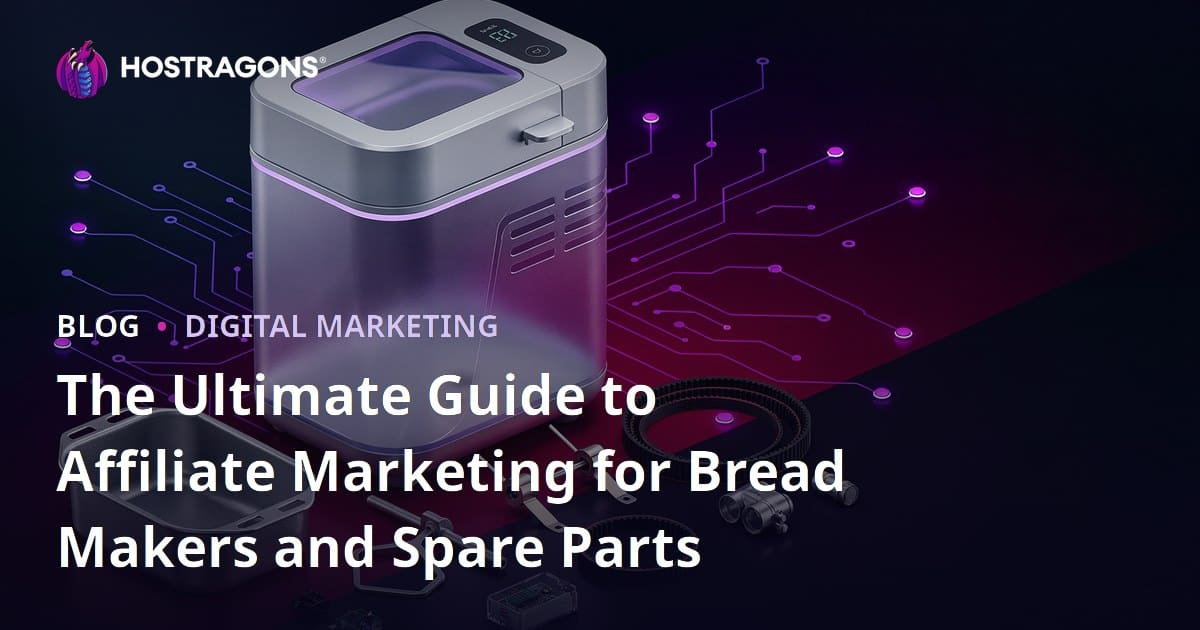
Affiliate marketing for bread makers and spare parts is a powerful niche strategy for those looking to reach a focused audience with a high intent to purchase. The goal of this model is to present content that compares bread makers, kneading paddles, baking pans, measuring cups, belts, heating elements, and compatible accessories, directing users to the right products and earning commissions through trusted affiliate links.
In 2026, simply publishing a list of products is not enough for SEO. Google evaluates user experience, genuine experience signals, expertise level, transparency, and the usefulness of content more rigorously. Therefore, a successful affiliate site should be built on a structure that is fast-loading, mobile-friendly, secure, technically clean, has a clear niche focus, and directly answers user questions. The advantage of focusing on bread makers is clear: a large portion of users are either in the buying phase or searching for compatible spare parts for their existing machines. This creates a high conversion potential with the right content strategy.
Why Is It Logical to Focus Solely on This Niche?
One of the most common mistakes in affiliate marketing is mixing different product categories on the same site. A site that promotes coffee machines today, camping tents tomorrow, and gaming chairs the day after does not send a clear signal of expertise to search engines. In contrast, a publication that focuses exclusively on bread makers and spare parts is much more conducive to establishing topic authority.
There are several concrete reasons why this niche makes sense. First, the products solve problems. Users want to make bread at home, reduce additives, experiment with gluten-free recipes, or replace a broken part. Second, searches for spare parts are often urgent. If a user has lost their kneading paddle, scratched their baking pan, or broken their belt, they want to quickly find a compatible product. Third, there is high content diversity. Comparison articles, brand model compatibility guides, recipe-supported content, maintenance guides, and troubleshooting articles can all be produced.
Additionally, home bread makers do not rely solely on one-time sales. A person who buys a machine may later look for spare bowls, kneading blades, measuring spoons, or cleaning accessories. This allows the affiliate site to be visible at multiple points in the customer journey.
Defining the Target Audience Accurately
Success in this niche starts with knowing exactly who you are writing for. Not every visitor comes with the same intent. Some users will be buying a machine for the first time, some are looking for compatible spare parts, and others want to achieve better results with their existing device. The tone of the content and product recommendations should be tailored to these intents.
1. First-Time Bread Maker Buyers
This group typically looks for simple, reliable, and cost-effective products. Criteria such as motor power, number of programs, bread capacity, timers, kneading quality, and service network should be clearly explained in the content. For example, a capacity of 750 grams is often sufficient for a family of two, while options of 1000 grams or more may be more suitable for larger families.
2. Current Users Seeking Spare Parts
This group has a higher purchase intent. What they are often looking for is brand and model compatibility. Parts should be clearly mentioned in the content: kneading paddle, bread pan, belt, lid gasket, heating element, motor gear, measuring cup, and measuring spoon. Users should be advised to check their model number, compare measurements in the seller's description, and review return policies.
3. Those Facing Recipe and Usage Issues
This group may not directly purchase a product, but if they gain trust, they may turn to the machine or accessory you recommend in the future. Offering practical solutions for issues such as bread collapsing, not rising, being hard on the outside, sticking to the pan, or the kneading paddle being stuck inside generates strong E-E-A-T signals.
Affiliate Site Infrastructure: Speed, Security, and Domain Name
No matter how good the content is, conversion rates drop on a slow and insecure site. In 2026 SEO standards, Core Web Vitals, mobile experience, secure connections, and technical accessibility remain critical. Choosing the right infrastructure at the outset when setting up an affiliate site reduces long-term costs.
A short, catchy, and topic-related domain name provides an advantage for a narrow-niche affiliate site. Names like breadmakerguide, homebreadguide, or machineparts could be considered as suitable brand names. It is important to avoid excessive use of hyphens, refrain from using special characters, and choose a name that allows for future brand expansion. The Domain Lookup and Domain Record page can be evaluated for domain name selection.
On the hosting side, fast SSD infrastructure, updated PHP versions, performance-focused server technologies like LiteSpeed, and regular backups stand out. An optimized package for a WordPress-based affiliate site will be sufficient at the start. As traffic grows, resources can be increased. At this stage, WordPress Hosting and Web Hosting Packages options are a sensible starting point.
An SSL certificate must be active. Users should feel that the site is trustworthy while reading product recommendations and clicking on links. A “not secure” warning in the browser undermines both user experience and brand perception. Therefore, the SSL Certificate setup should be completed on day one.
How to Establish a Keyword Strategy?
In this niche, the keyword plan should not consist solely of high-volume keywords. The real value lies in long-tail keywords with strong purchase intent. For example, the phrase “best bread maker” may be competitive; however, queries like “x brand bread maker kneading paddle,” “bread maker pan dimensions,” or “gluten-free bread maker recommendations” carry clearer intent.
Keyword Groups
- Product comparison: best bread maker, cost-effective bread maker, bread maker for small family.
- Spare parts: bread maker kneading paddle, bread maker pan, bread maker belt, bread maker blade.
- Compatibility: is the brand model bread maker pan compatible, spare paddle dimensions, where is the model number written.
- Troubleshooting: why is the bread maker not rising, why does the bread stick to the pan, why is the kneading paddle not turning.
- Recipe-supported: whole wheat bread in a bread maker, gluten-free bread, sourdough bread maker recipe.
For a good plan, 10-20 supporting contents can be created under each main category. For instance, in the spare parts category, a general guide can be published first, followed by brand and part-specific sub-contents. This approach establishes topical authority and ensures that pages support each other through internal linking.
Content Types and Publishing Schedule
Publishing only the best product lists on an affiliate site may not appear natural. Content needs to be produced for every stage of the user journey. The table below summarizes which content types can be used for what purpose in this niche.
| Content Type | Search Intent | Example Title | Conversion Potential |
|---|---|---|---|
| Comparison | Purchase | Top 7 Bread Makers for 2026 | High |
| Spare parts guide | Urgent solution | How to Choose a Bread Maker Kneading Paddle? | Very High |
| Brand model compatibility | Verification | Compatible Parts for X Model Bread Maker Pan | High |
| Troubleshooting | Information gathering | Why Is My Bread Maker Not Kneading? | Medium |
| Recipe content | Usage improvement | Gluten-Free Bread Recipe in a Bread Maker | Medium |
The first 90 days for a new site can be critical. In the first month, basic category pages and 8-10 guide contents can be published. In the second month, product comparisons can be intensified, and in the third month, content on spare parts and model compatibility can be concentrated. Two quality contents per week are worth more than five weak contents scattered randomly.
How to Establish Trust in Product Reviews?
Trust is fundamental to conversions in affiliate content. Users are now looking for realistic assessments, not just glowing reviews. When introducing a bread maker, it is not enough to simply list the number of programs. The machine's pan capacity, the space it occupies on the countertop, noise level, ease of cleaning, availability of spare parts, and success in recipes should all be considered together.
Providing concrete examples enhances trust. For instance, it can be noted that a device with a capacity of 750 grams is more practical for 2-3 person households, while a capacity of 1000-1250 grams may be more suitable for larger families. Similarly, it can be explained that models with double kneading paddles may yield more balanced results in large doughs but may require a bit more effort in cleaning compared to single paddle models.
In spare parts content, the most important point to pay attention to is the compatibility warning. The structure of the pan hooks, shaft diameter, or paddle size may vary between models produced by the same brand in different years. Therefore, alongside every product recommendation, model number checks, seller measurement information, user reviews, and return policies should be reviewed. Such warnings protect the user and enhance the site's reliability.
Conversion-Focused Page Structure
An affiliate page should not just be a pile of text. When a user arrives on the page, they should be able to make a quick decision. For this, there should be a brief summary at the top of the page, followed by selection criteria, a comparison table, detailed product reviews, pros and cons lists, and a frequently asked questions (FAQ) section.
Recommended Page Flow
- A clear answer in the first paragraph and who it is suitable for.
- A brief decision table: best overall, budget-friendly, large family, model with easily available spare parts.
- Selection criteria: capacity, program, power, pan quality, service, and spare parts.
- Product reviews: advantages, disadvantages, suitability.
- Pre-purchase checklist.
- FAQ section and internal links to related content.
Button texts should not be exaggerated. Instead of pressuring phrases like “Buy Now,” more natural expressions like “Check Price,” “See Current Options,” or “Explore Compatible Parts” can be preferred. It should be transparently stated that affiliate links are sponsored or part of a revenue-sharing arrangement.
Technical SEO and Performance Checklist
Google bots need to be able to crawl the content easily, and users need to navigate the page quickly. Technical SEO has a direct impact on revenue for affiliate sites because a slow page means fewer clicks and lower conversions.
- Mobile speed: Pages should be optimized to open in under 3 seconds.
- Image optimization: Product images should be in WebP format and compressed.
- Heading hierarchy: Each page should have a single main heading with a consistent H2 and H3 structure.
- Schema usage: FAQ, Article, Breadcrumb, and Product schema should be applied where appropriate.
- Internal linking: Links should be provided from main guides to sub-part contents and from sub-contents to category pages.
- Broken link check: Affiliate links should be tested regularly.
- Security: SSL, strong admin passwords, regular backups, and updated plugins are mandatory.
If you are using WordPress, it is important to keep the theme simple. Heavy sliders, unnecessary animations, and too many tracking codes can slow the page down. For starters, a lightweight theme, caching plugin, image compression, and security plugin will be sufficient. Content such as WordPress Security Guide can also be supportive for site security and regular maintenance.
Affiliate Revenue Model and Commission Calculation
In this niche, revenue can come not only from high-priced machines but also from the continuity of spare part sales. For example, a 3000 TL bread maker with a 4% commission yields 120 TL, while a 250 TL kneading paddle with an 8% commission yields 20 TL. While this may seem low at first glance, spare part content can be more specific and have a higher conversion rate.
Let’s do a hypothetical calculation. If a niche site receives 20,000 organic visitors monthly and 18% of those visitors click on affiliate links, that results in 3600 exit clicks. If 3% of those clicks convert to sales, 108 sales are achieved. If the average commission is 45 TL, the monthly revenue would be 4860 TL. Higher product prices, better rankings, and an email list can increase this figure. Of course, this is not guaranteed income; traffic quality, product price, commission rate, and vendor trust will determine the outcome.
Points to Consider in Spare Parts Content
Spare parts pages are among the most valuable assets in this niche. This is because users have often experienced a malfunction, researched solutions, and are close to making a purchase. However, incorrect guidance can lead to a loss of trust and return issues. Therefore, technical details should be carefully crafted in part content.
Information to Check
- The brand and full model code of the machine.
- Pan capacity and connection hook structure.
- The shaft diameter and seating form of the kneading paddle.
- Whether the part is original or compatible.
- The seller's return policy and user reviews.
- Whether the part is made from food-grade materials.
In the content, users should be advised to compare the old part's photo and measurements with the seller's description before purchasing. Particularly in mechanical products requiring compatibility, even a few millimeters of difference can cause the part not to work.
Internal Linking and Site Architecture
Building a strong architecture in narrow niche sites boosts ranking performance. Links should be provided from the homepage to main categories, from category pages to product guides, and from product guides to spare parts and troubleshooting contents. This way, both users and bots can more easily understand the relationships between topics.
An example structure could be: homepage, bread makers category, spare parts category, recipes category, and troubleshooting category. In the bread makers category, there would be content on the best models, models for small families, and models for gluten-free bread. In the spare parts category, kneading paddles, pans, belts, and measuring accessories would be processed as separate pages.
To support the establishment of such an affiliate site on the Hostragons blog, natural links can be added to topics like How to Create a Website, Setting Up an SEO Compatible WordPress Site, and Website Speed Optimization. These links provide additional resources to users and strengthen the internal authority distribution of the site.
2026 E-E-A-T Compliant Publishing Principles
Google's quality assessment approach focuses on transparent and useful information, especially in affiliate content. Genuine experience signals are crucial for E-E-A-T. If you have the opportunity to test products, share your own photos, measurements, and usage notes. For products you haven't tested, clearly state this and explain that your assessment is based on technical specifications, user reviews, service information, and price comparisons.
The author's biography should not be neglected. If the author has experience in kitchen technologies, small appliances, or product reviews, it should be briefly and realistically stated. The publication date and update date should be visible. Because pricing and stock information can change, product contents should be checked at least every three months.
Additionally, the affiliate disclosure must be clear. It can be communicated to the reader that shopping through the links will earn the site a commission without any additional cost to them. This transparency does not reduce trust; rather, it creates a professional publishing impression.
30-Day Action Plan for Beginners
A simple 30-day plan can be implemented for those wanting to enter this niche. In the first week, the domain name, hosting, SSL, theme, and basic pages are set up. About, contact, privacy policy, and affiliate disclosure should definitely be included. In the second week, the main category structure is established and the first 5 basic guides are published. The third week begins with spare parts content. In the fourth week, comparison tables, internal linking, and Search Console checks are performed.
- Days 1-3: Niche validation, competitor analysis, domain selection.
- Days 4-7: Hosting, SSL, WordPress, and theme setup.
- Days 8-14: Main guides and category pages.
- Days 15-21: Long-tail content focused on spare parts.
- Days 22-30: Technical SEO, speed optimization, internal linking, and tracking setup.
The aim of this plan is not to quickly produce hundreds of contents. The goal is to establish a solid foundation and provide quality answers to the questions that users are genuinely searching for. Regular updates and data analysis can reveal over time which contents contribute more to sales.
Common Mistakes to Avoid
The biggest mistake in this area is copying and publishing product descriptions. Non-original content not only decreases SEO performance but also does not add value for the user. The second mistake is to present every product as the best. Unrealistic praise undermines trust. The third mistake is to use definitive statements about spare part compatibility without checking. Generalizations like “the part fits all models” should be avoided.
Additionally, filling pages with ads and pop-ups disrupts the mobile experience. Affiliate links should be placed naturally in the content and should not be overly dense to disturb the user. Finally, technical maintenance should not be neglected. Unupdated plugins, broken links, and slow servers can reduce organic traffic in the long run.
Frequently Asked Questions
Is affiliate marketing for bread makers and spare parts a profitable niche?
Yes, it can be profitable with the right content strategy. A significant portion of users search with the intention to purchase or replace parts. While spare part queries may seem low volume, they can have high conversion rates.
Is WordPress sufficient for this niche?
Yes. With fast hosting, a lightweight theme, SSL, caching, and basic SEO plugins, WordPress is sufficient for such affiliate sites. As traffic increases, stronger hosting packages can be transitioned to.
Can affiliate content be written without testing the products?
It can be written, but it is important to be transparent. For untested products, assessments should be made based on technical specifications, user reviews, service networks, spare part availability, and price comparisons; it should not be implied that personal testing has been done if it hasn't.
What is the most important SEO opportunity in spare parts content?
Long-tail queries that include brand, model, and part names are crucial. For example, a user looking for a kneading paddle or pan for a specific model is closer to making a purchase than a user looking for general information.
Is SSL really necessary on an affiliate site?
Yes. SSL is mandatory for user trust and modern web standards. A site without a secure connection raises doubts for visitors and can negatively impact conversion rates.
In summary, focusing solely on bread makers and spare parts for affiliate marketing can turn into a sustainable digital income model with the right infrastructure, clear niche focus, quality content, and trustworthy guidance. Establishing a strong domain, fast hosting, and SSL for the technical foundation, followed by producing content based on user intent, is the healthiest path. If you’re ready, you can explore domain and hosting options through Hostragons to calmly and systematically build your project's technical foundation.